Where Folklore Inspires Art
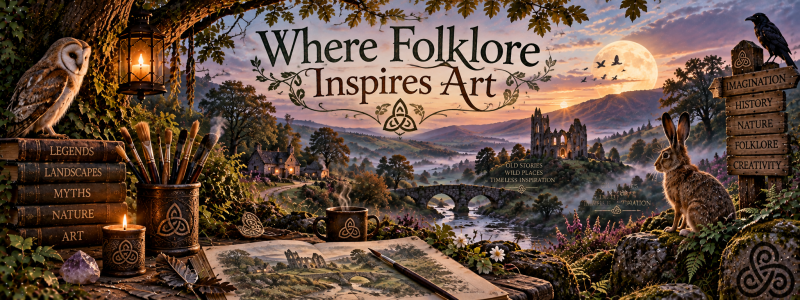
When an Old Story Becomes an Image
Folklore begins with words.
A story told beside a fire. A warning whispered about an ancient tree. A tale of fairies beneath a hill. A mysterious animal glimpsed crossing a moonlit field. A legend attached to a ruined castle, lonely road or forgotten well.
But stories also create pictures in our minds.
When we hear about the Wild Hunt racing across a stormy sky, we imagine the horses, clouds and moonlight. When we read about the Aos Sí beneath an ancient mound, we begin to picture the hidden world below the grass. When a Welsh story describes Blodeuwedd becoming an owl, flowers, feathers and transformation become part of the same image.
That is where folklore and art meet.
The story becomes something we can see.
The Landscape Comes First
Much of my artwork begins not with a mythical creature, but with a landscape.
A misty valley.
An old stone bridge.
A woodland path.
A ruined abbey.
A river disappearing between hills.
A lone hawthorn growing in a field.
These places already feel as though they contain stories.
Britain and Ireland are filled with landscapes where centuries seem to exist beside one another. A prehistoric standing stone can overlook a medieval church. An ancient track can pass a modern farmhouse. A river can flow beneath a bridge that generations have crossed before us.
The landscape provides the stage.
Folklore tells us what might be hiding within it.
Somewhere Between Reality and Imagination
The images on these pages are not intended to show exactly what people in the past saw.
Nobody knows what a fairy looked like.
Nobody photographed the Wild Hunt.
Nobody can tell us exactly how an ancient storyteller imagined the Otherworld.
That uncertainty creates room for imagination.
I like my artwork to exist somewhere between a real landscape and a remembered dream.
The trees should feel familiar.
The rivers should look as though you could follow them.
The cottages should feel warm enough to enter.
But somewhere beyond the firelight, something unusual may be waiting.
A raven watches from a branch.
A hare sits beside a standing stone.
A strange light appears beneath an ancient mound.
The ordinary world has not disappeared.
It has simply become slightly more mysterious.
The Animals That Carry Stories
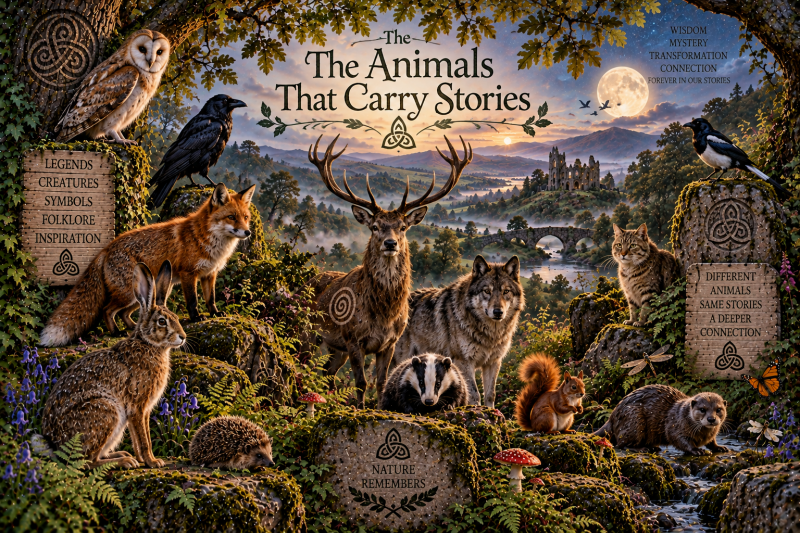
Animals appear constantly throughout my work because they appear constantly throughout folklore.
The hare carries stories of transformation, witches and mystery.
The raven brings associations with prophecy, battle and the Otherworld.
The owl belongs to darkness, silence and the transformation of Blodeuwedd.
The fox moves quietly between the human landscape and the wild.
The stag carries the atmosphere of ancient woodland and untamed places.
Even familiar animals can become different when placed inside a story.
A hare in a field is wildlife.
A hare sitting beneath a full moon beside an ancient stone becomes a question.
That small change is where folklore begins.
Trees as Characters
Trees are never simply background decoration in these images.
The twisted hawthorn beside a path may belong to the Fair Folk.
The rowan beside a cottage may represent protection.
The hazel growing beside sacred water may suggest wisdom.
The ancient oak carries strength, memory and centuries of changing seasons.
Old trees have enormous visual power because they already look as though they remember things.
Their trunks twist.
Branches break and regrow.
Roots disappear underground.
Hollows develop.
Generations of people pass beneath them while the tree remains.
In folklore-inspired art, a tree can become a character without ever moving.
Water Creates Mystery
Water appears again and again throughout my artwork.
Rivers.
Wells.
Waterfalls.
Pools.
Lakes.
Mountain streams.
Water immediately changes the atmosphere of an image because it reflects the world around it.
A moon becomes two moons.
A castle appears upside down.
Lantern light breaks across ripples.
Mist forms above the surface.
And beneath the water is somewhere we cannot see.
That hidden depth makes water perfect for folklore.
The visible landscape exists above.
Another unknown world lies below.
Mist — Where the Landscape Disappears
Few things transform a familiar landscape faster than mist.
A hill disappears.
A tree becomes a silhouette.
The opposite bank of a river vanishes.
Distances become impossible to judge.
Mist allows an artist to hide part of the world.
And what cannot be seen can be imagined.
Perhaps there is only another field beyond the mist.
Perhaps there is a ruined castle.
Perhaps there is an ancient mound.
Perhaps there is something watching.
Folklore has always grown particularly well in places where certainty disappears.
Moonlight and the Hidden Landscape
Daylight shows us detail.
Moonlight removes it.
Under a full moon, colours fade and familiar shapes become uncertain.
A tree stump might resemble a crouching animal.
A branch becomes an arm.
A distant person becomes a shadow.
This is why moonlight appears so often in folklore-inspired art.
It allows the real landscape to remain visible while changing its character completely.
The countryside you walked through during the afternoon becomes another place after dark.
Same road.
Same trees.
Same hills.
Different world.
Firelight — The Human World
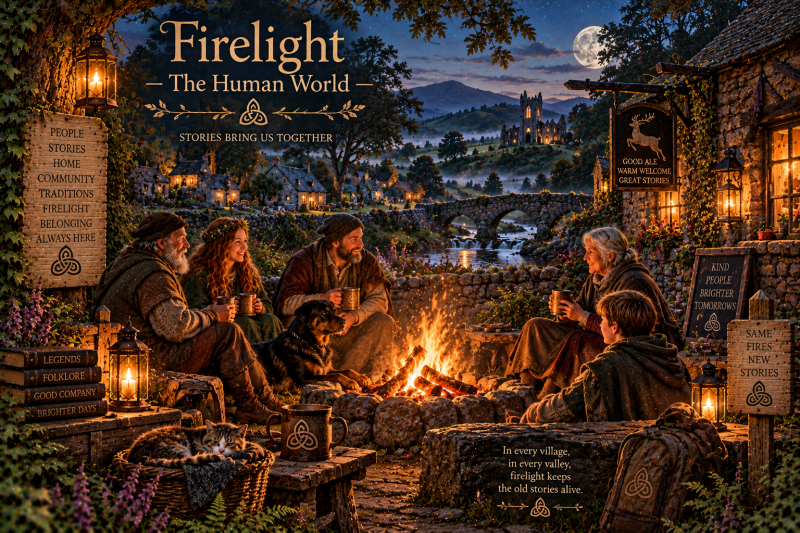
If moonlight represents the mysterious landscape, firelight often represents the human one.
A lantern hanging from a tree.
A candle beside a sacred well.
Light glowing through a cottage window.
A bonfire on a distant hill.
These small warm lights matter because they create a sense of safety.
Outside is darkness.
Inside is warmth.
For thousands of years, human beings gathered around fire while the night existed beyond the circle of light.
Many of the stories we now call folklore were probably told in exactly that setting.
Firelight therefore belongs naturally inside the artwork.
It is the place where stories begin.
Ancient Stones
Standing stones, stone circles and burial chambers immediately connect an image with deep time.
They remind us that people lived in these landscapes thousands of years before us.
We may understand much more about prehistoric monuments through archaeology today, but many questions remain.
Later generations had even fewer answers.
They created stories.
Fairies lived beneath the stones.
Giants placed them there.
Witches moved them.
Kings slept beneath them.
Ancient monuments therefore sit at the meeting point between archaeology and imagination.
They are real objects surrounded by unreal stories.
For an artist inspired by folklore, few subjects are more powerful.
Ruins and Lost Stories
I often include ruined castles, chapels, cottages and abbeys because ruins leave part of their story unfinished.
A complete building tells you what it is.
A ruin asks you what it was.
Who walked through that doorway?
Who looked through that window?
Why was the building abandoned?
What happened there?
Nature slowly enters the structure.
Ivy climbs the walls.
Trees grow nearby.
Stone falls.
Eventually architecture begins returning to the landscape from which it came.
That mixture of human history and nature creates exactly the atmosphere in which folklore thrives.
The People in the Landscape
Human figures in my folklore artwork are often small compared with the landscape around them.
That is deliberate.
The person is not always the most important thing in the picture.
The hill may be older.
The tree may have seen generations pass.
The river may continue flowing long after the person has gone.
A traveller standing at a crossroads or beside a sacred well becomes part of a much larger story.
They are experiencing the landscape.
Just as we are.
Symbols Hidden in the Artwork
Celtic knots, spirals, triskelions and other decorative motifs appear throughout my work.
Sometimes they are obvious.
Sometimes they are carved into stones, woven into clothing or hidden within the landscape.
These symbols help connect the artwork visually with the traditions that inspired it.
But I also like them to feel as though they belong there.
A carving weathered by centuries should not look newly painted.
A symbol on an ancient stone should feel worn by rain.
The details help create the illusion that the image has its own history.
Colour and the Seasons
The Wheel of the Year provides an extraordinary natural colour palette.
Imbolc brings pale greens, white snowdrops and the first signs of returning life.
Ostara brings blossom and fresh spring colour.
Beltane explodes into green woodland, flowers and fire.
Litha is filled with sunlight and the deep greens of midsummer.
Lughnasadh turns the fields gold.
Mabon fills orchards and woodland with amber, red and brown.
Samhain introduces mist, bare branches, firelight and darkness.
Yule brings frost, evergreens, snow and the returning light.
The landscape itself provides the colours.
The artist simply follows the Wheel.
Folklore Without Losing the Truth
One of the challenges of creating folklore-inspired artwork is balancing imagination with history.
A beautiful image can easily make something look historically certain when it is not.
For example, a modern Pagan symbol may look perfectly natural beside an ancient stone, but that does not mean prehistoric people carved that symbol there.
A fairy may appear beside a burial mound in an illustration, but archaeology does not tell us fairies built the mound.
The artwork represents story and imagination, not archaeological reconstruction.
That distinction matters.
We can enjoy the magic without pretending imagination is evidence.
Art Can Preserve a Story
Some folklore survives because somebody wrote it down.
Some survives in songs.
Some survives through local place names.
Art offers another way of keeping stories alive.
An image of Blodeuwedd becoming an owl may encourage someone to discover the Mabinogi.
A picture of Boann beside the Well of Segais may lead someone towards Irish mythology.
An illustration of a black dog on a lonely road may introduce someone to the regional legends surrounding Black Shuck.
The artwork becomes a doorway.
The viewer sees the image first.
Then they ask:
What is the story behind this?
Old Stories, New Tools
Artists have always used the tools available to them.
Pigment on stone.
Ink on parchment.
Paint on canvas.
Printing presses.
Photography.
Digital painting.
And now artificial intelligence can also become part of the creative process.
The technology is new.
The human desire behind it is not.
We are still doing something our ancestors did beside fires thousands of years ago.
We imagine something that does not physically exist.
Then we try to give it a form that another person can experience.
The tool changes.
Storytelling continues.
Creating a World Rather Than a Picture
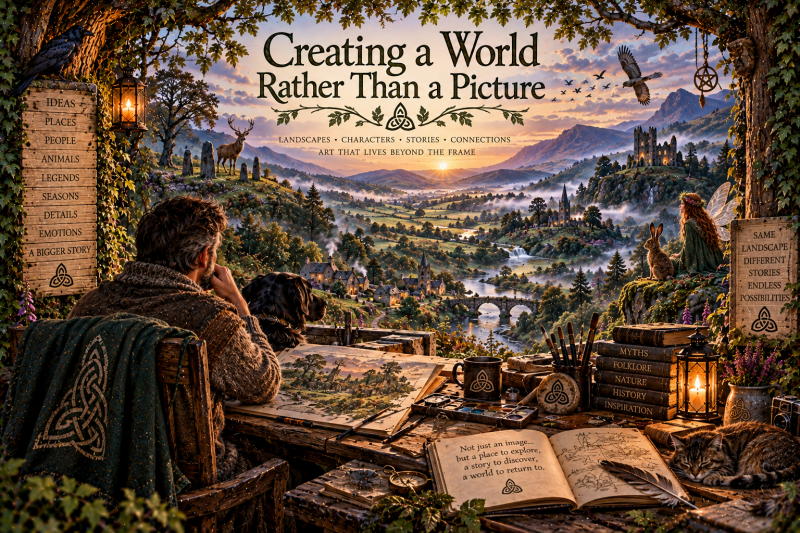
For me, the most successful folklore artwork feels as though the scene continues beyond the edges of the image.
The road goes somewhere.
The river has a source.
Someone lives inside the cottage.
The ruined castle has a history.
The standing stones have witnessed something.
The person beside the fire has a reason for being there.
Even if none of those stories are written, the image should make you imagine them.
That is the difference between simply illustrating an object and creating a world.
I want the viewer to feel that they could step into the landscape and keep walking.
The Small Details Matter
Sometimes the smallest element creates the entire story.
A lantern left burning beside an empty path.
Coins beneath the water of an old well.
A ribbon moving from a hawthorn branch.
A raven watching from a ruined wall.
Footprints disappearing into mist.
A cottage window glowing far across a valley.
These details suggest that something happened before we arrived.
Perhaps someone has just left.
Perhaps someone is coming.
Perhaps something is still there.
The picture does not need to explain everything.
Folklore rarely does.
Why Folklore Still Inspires Art
We live in a world where almost everything can be mapped, photographed and explained.
Yet people still love mysterious stories.
We still visit ancient stones.
We still photograph moonlit landscapes.
We still tell ghost stories.
We still wonder about ruined buildings.
We still stop when an owl calls unexpectedly from the darkness.
Knowledge has not destroyed wonder.
If anything, understanding how extraordinary the real natural world is can make folklore even more interesting.
The old stories show us how previous generations experienced that same sense of wonder.
The Story Belongs to the Viewer Too
Once an artwork is finished, I know what inspired it.
But the viewer may see something completely different.
One person notices the moon.
Another notices the dog beside the traveller.
Someone else is drawn immediately to the standing stones.
Another person sees a landscape that reminds them of somewhere they knew as a child.
That is one of the things I love most about creating folklore-inspired artwork.
The image begins with my imagination.
But it does not end there.
The viewer brings their own memories and stories into it.
Somewhere Beyond the Lantern Light
Imagine an old path disappearing through woodland.
The sun has already gone down.
A lantern hangs from a branch beside the road.
Beyond it stands an ancient stone.
A river can be heard somewhere below.
Mist is gathering between the trees.
A hare watches from the edge of the path.
Far away, one cottage window still glows.
Nothing supernatural has happened.
Not yet.
Perhaps nothing will.
But the landscape feels as though it could.
That possibility is what inspires so much of my artwork.
The space between what we know and what we imagine.
Between history and legend.
Between daylight and darkness.
Between the familiar landscape and the stories hidden within it.
That is where folklore inspires art.
Not by recreating the past exactly as it was, but by allowing its stories, landscapes and mysteries to become something new.
The old tale is told again.
This time, not beside the fire.
This time, in an image.