The Blackthorn in British, Irish & Celtic Folklore
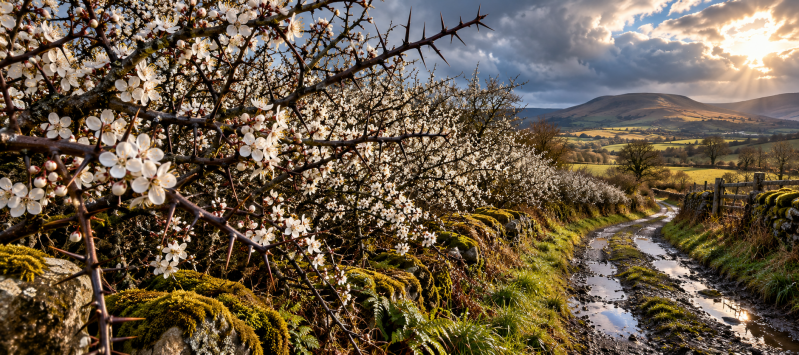
Dark-barked, densely thorned and capable of producing clouds of white blossom while much of the countryside still appears bare, blackthorn is one of the most distinctive plants of the British and Irish hedgerow.
Its fruit — the sloe — has been gathered for generations, while its hard wood became useful for walking sticks, tool handles and, particularly in Ireland, the famous shillelagh. Dense blackthorn also formed formidable hedges and boundaries around fields.
Yet blackthorn developed a considerably darker folkloric reputation. Its long sharp thorns became associated with danger, protection, witchcraft and harmful magic, while later traditions connected the plant with winter, hardship and supernatural figures.
In the later Ogham tree tradition, blackthorn became associated with Straif. Modern Pagan writers have subsequently developed extensive symbolism around the plant, often connecting it with adversity, transformation, protection and the darker part of the year.
Some popular claims — particularly those linking blackthorn directly with Samhain, the Cailleach or an ancient Celtic system of magical trees — require more careful examination. Recorded folklore, medieval tradition and modern Pagan interpretation are not always the same thing.
Blackthorn's real story is richer because of this complexity: a plant of beautiful spring blossom and vicious thorns, autumn sloes and winter-dark branches, practical hedgerows and unsettling folklore.
Straif — Blackthorn & the Ogham Tradition
Blackthorn is commonly associated with Straif, one of the letters of the Ogham alphabet. As with the other trees and plants connected with Ogham, however, modern interpretations often go considerably further than the surviving early evidence.
The earliest Ogham inscriptions were primarily a means of recording names, ancestry and relationships. The elaborate system of tree meanings familiar from modern books developed through later medieval scholarship and, eventually, modern spiritual interpretation.
Blackthorn's physical character made it particularly suited to darker symbolism. Its branches carry formidable thorns, yet in early spring they can suddenly become covered with delicate white blossom before the leaves appear.
Modern Pagan and Druid traditions often associate Straif with adversity, discipline, protection, transformation and overcoming hardship. These can be meaningful contemporary interpretations, but they should not automatically be presented as teachings handed down unchanged from ancient Druids.
Blackthorn's genuine place within the later Ogham tradition is interesting enough without adding certainty where the historical evidence does not provide it.
Blackthorn or Hawthorn? — Two Very Different Thorn Trees
Blackthorn and hawthorn are frequently confused, yet they are different plants with their own appearances, uses and traditions.
Blackthorn (Prunus spinosa) usually produces white blossom on dark, thorny branches before its leaves fully emerge. Later in the year it bears the dark blue-black fruits known as sloes.
Hawthorn (Crataegus monogyna) generally flowers later, after its leaves have appeared, producing the familiar May blossom followed by red haws in autumn.
Their folklore also developed differently. Hawthorn became particularly associated with May, boundaries and fairy tradition, while blackthorn acquired stronger associations with harsh weather, defensive hedges, walking sticks and darker forms of folk magic.
The two could of course grow within the same traditional hedgerow, which helps explain why their stories sometimes overlap. But treating every thorn tree as interchangeable can hide some of the most interesting details of their individual folklore.
Blackthorn, Witches & Darker Folk Magic
Blackthorn developed a darker reputation than many other familiar hedgerow plants. Its long sharp thorns, almost black branches and dense impenetrable growth made it a natural plant around which ideas of danger and defensive magic could develop.
In later British and Irish folklore, blackthorn sometimes became associated with witchcraft, cursing and harmful magic. Blackthorn sticks or thorns appear in stories and magical traditions in which the plant could be imagined as a weapon as well as a source of protection.
Yet this reputation needs some caution. Modern accounts sometimes portray blackthorn as though it were universally regarded as the “witches' tree” by the ancient Celts. The historical evidence does not support such a simple claim. Beliefs differed between places and periods, and much of the elaborate magical symbolism repeated today comes from later folklore and modern occult or Pagan writing.
Blackthorn's threatening appearance probably contributed considerably to its reputation. A thorn capable of causing a painful wound naturally provided powerful imagery for danger, defence and retaliation.
Like many plants in folk belief, blackthorn could therefore occupy both sides of the boundary: something capable of causing harm could also become something imagined to guard against harm.
Blackthorn & the Cailleach — An Ancient Connection?
Modern folklore and Pagan writing frequently connect blackthorn with the Cailleach, the mysterious hag-like figure associated with winter, landscape and sovereignty in Gaelic tradition.
The association is certainly evocative. Blackthorn's dark branches, fierce thorns and ability to flower while the countryside still feels wintry make it an almost perfect visual companion for stories of the Cailleach.
However, claims that blackthorn was universally the Cailleach's sacred tree in ancient Celtic religion should be treated cautiously. The surviving Gaelic traditions surrounding the Cailleach are complex and regional, and they do not provide a simple ancient system assigning her ownership of blackthorn.
Later folklore and modern Paganism have strengthened the connection, often using blackthorn to represent winter, hardship, boundaries and transformation.
This distinction does not make the modern symbolism less interesting. Instead, it allows us to appreciate both the older traditions of the Cailleach and the ways in which people continue to build new meanings around one of the countryside's most striking thorn plants.