The Ash Tree in British, Irish & Celtic Folklore
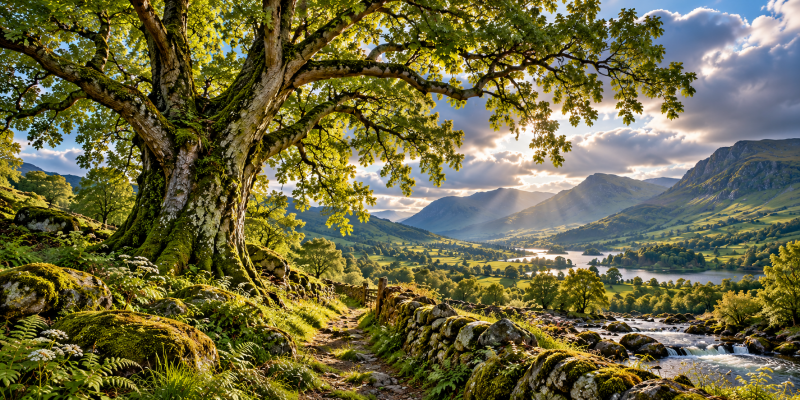
Tall, fast-growing and remarkably useful, the ash has been part of the landscapes and everyday lives of people across Britain and Ireland for centuries. Its strong yet flexible timber made it valuable for tools, handles, furniture, wheels and weapons, while folklore surrounded the living tree with traditions of protection, healing and supernatural power.
Ash also appears in early Irish tradition. Important individual trees could become landmarks associated with territories and communities, and several celebrated sacred or legendary trees recorded in medieval Irish literature were described as ashes.
In the Ogham tradition, ash became associated with Nion, although—as with the other Ogham trees—the elaborate spiritual meanings commonly attached to it today developed over a much longer period.
British folk tradition gave ash an extraordinary range of supposed powers. The tree appears in customs intended to protect children, cure illness and guard against harmful influences, while its wood was used for staffs, walking sticks and countless practical objects.
Ash is also frequently confused with the World Tree of Norse mythology. Yggdrasil belongs to Norse rather than Celtic tradition, even though its famous association with ash has influenced modern ideas about the tree.
The real folklore of ash is therefore more complicated—and more interesting—than simply calling it a “Celtic World Tree”. It brings together Irish sacred trees, healing customs, protection, Ogham, craftsmanship and centuries of life in the working countryside.
Sacred Ash Trees of Ireland
Medieval Irish literature preserves traditions of extraordinary trees that were important enough to become associated with territories, communities and legendary landscapes. These are sometimes described as the great or sacred trees of Ireland.
Several traditions concern enormous trees believed to stand at important places. Among the best known is the Tree of Uisneach, associated with the ancient ceremonial landscape of Uisneach in County Westmeath. Medieval texts describing Ireland's celebrated trees include ashes among these remarkable landmarks.
Such trees were more than useful sources of timber. A prominent tree could serve as a meeting place, territorial landmark or symbol of prosperity and authority. Stories about its destruction could therefore represent something much greater than the loss of a single tree.
Early Irish literature contains numerous references to significant trees, but caution is needed with the modern expression “Celtic sacred tree.” Different trees belonged to different stories, places and periods; there was not necessarily one universal Celtic system in which every ash carried the same religious meaning.
What the surviving material does demonstrate is that individual trees could become enormously important within the cultural landscape. An ancient ash standing over generations could become part of the identity and memory of an entire place.
Nion — Ash & the Ogham Tradition
Ash is commonly associated with Nion, one of the letters of the Ogham alphabet. As with birch and Beith, however, the relationship between Ogham letters and trees is more complicated than many modern “Celtic tree alphabet” charts suggest.
Ogham began as a writing system rather than a tree-based system of divination. Surviving inscriptions principally record names and relationships, while medieval scholars later preserved and developed associations between individual letter names, trees and other categories.
Modern Druidry and Pagan spirituality have expanded Nion's connection with ash considerably, associating the tree with ideas such as connection, strength, transformation and spiritual journeys.
These contemporary meanings can form meaningful living traditions, but they should be distinguished from what can actually be demonstrated from early Irish sources.
Ash nevertheless has a genuine place within the later Ogham tree tradition. The interesting story is not that the Druids left us a complete “ash horoscope”, but that an early Irish alphabet eventually became intertwined with centuries of tree symbolism.
Is Ash the World Tree? Yggdrasil & Celtic Tradition
Ash is frequently described online as the “Celtic World Tree”, but this claim needs some careful untangling. The most famous World Tree associated with ash belongs not to Celtic mythology but to Norse tradition.
In Old Norse literature, Yggdrasil is the immense cosmic tree around which the worlds of Norse mythology are organised. The Prose Edda describes Yggdrasil as an ash, although scholars have debated aspects of the tree's identity and symbolism.
Irish tradition certainly contains important and sometimes extraordinary trees. Medieval literature records great trees associated with particular territories and landscapes, while trees can also appear at significant supernatural locations. However, there is no straightforward Irish equivalent in which an ash called Yggdrasil supports the entire Celtic cosmos.
The confusion is understandable. Both Celtic and Norse traditions contain powerful tree imagery, and modern Pagan spirituality often draws inspiration from several pre-Christian European cultures. Over time, ideas from those traditions can become blended together.
Ash therefore has genuine importance in Irish tradition without needing to borrow Yggdrasil. Keeping the traditions separate actually makes both more interesting: Norse mythology has its World Tree, while Irish literature preserves its own remarkable traditions of great trees, sacred landscapes and supernatural places.
Ash, Healing & Folk Medicine
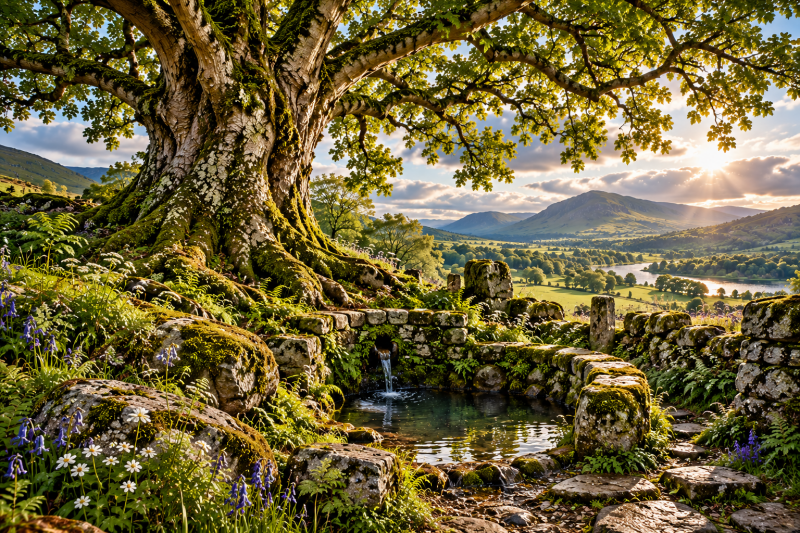
Ash acquired an extraordinary reputation for healing in British folk tradition. Remedies involving the tree were recorded for a variety of illnesses, although these practices belonged to folk medicine rather than modern evidence-based healthcare.
One particularly striking custom involved passing a sick child through a split ash tree or sapling. The tree was carefully divided, the child passed through the opening and the trunk bound together again. In some versions of the tradition, the child's recovery became symbolically connected with the tree healing itself.
Ash also appeared in remedies involving its leaves, bark or wood, while particular trees could acquire local reputations for curing specific complaints.
These practices reveal an older way of understanding illness in which symbolic action, natural materials, religious belief and practical medicine could exist alongside one another.
Today such traditions are valuable as folklore and social history rather than medical advice. They show how the living tree itself could become part of a ritual of hope, recovery and renewal.
Ash, Protection & Folk Belief
Ash was also surrounded by traditions of protection. In different parts of Britain, pieces of ash wood, leaves or particular ash trees could be credited with guarding people or animals against illness and harmful influences.
Some traditions concerned newborn children. Ash might appear in protective customs intended to safeguard a baby during a period when both mother and child were considered particularly vulnerable.
Ash also became associated with protection against snakes and serpents. Old European traditions sometimes claimed that snakes avoided the tree or could be repelled by ash wood. Such beliefs belonged to folklore rather than natural history, but they contributed to the tree's wider protective reputation.
As with rowan, elder and holly, these customs varied greatly between regions. There was no single set of rules governing how ash should be used throughout Britain and Ireland.
What emerges instead is a recurring idea that certain trees possessed qualities extending beyond their practical value. Ash could provide timber and fuel, but in folklore it might also provide an invisible form of protection.
Ash Wood — Spears, Staffs & the Working Countryside
Ash timber has an unusual combination of strength, flexibility and resistance to shock, qualities that made it exceptionally valuable long before modern materials became available.
Straight ash poles could be used for spear shafts and staffs, while later generations relied upon the wood for tool handles, agricultural implements, furniture and parts of carts and wagons. Its ability to withstand repeated impact made it particularly suitable for objects expected to endure hard use.
This practical importance helps explain why ash became so familiar within rural life. It was not simply a mysterious tree standing at the edge of a sacred landscape; its wood could be present in the tools people worked with every day.
Walking sticks and staffs also acquired their own associations in folklore and storytelling. A staff made from a familiar and durable tree could easily become part of tales involving travellers, healers or figures possessing unusual knowledge.
The history of ash therefore joins the mythical and practical worlds. Medieval Irish literature could celebrate extraordinary individual trees while ordinary ash wood was being shaped into the objects that allowed people to farm, travel, build and fight.
Ash in British & Irish Folklore
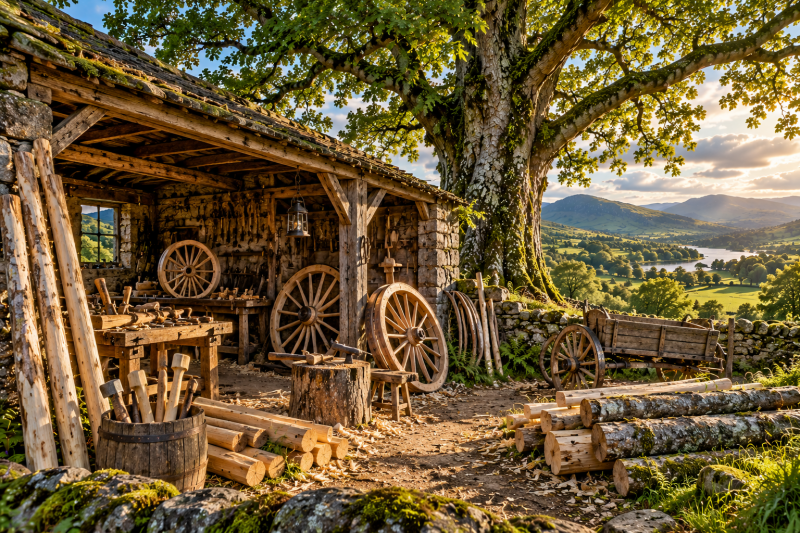
Across Britain and Ireland, ash occupied an unusual position between the ordinary and extraordinary. It was one of the countryside's most useful trees, yet folklore also surrounded it with traditions of healing, protection and supernatural significance.
In Ireland, medieval literature preserves memories of remarkable individual trees connected with important territories and landscapes. These great trees could become symbols of a place itself, demonstrating that the significance of a tree could extend far beyond the value of its timber.
British folk tradition developed particularly rich healing customs around ash. Sick children might be passed through a split tree, while leaves, wood and particular trees acquired reputations for curing illness or protecting people from harm.
At the same time, generations of craftspeople valued ash for entirely practical reasons. Its strong, flexible timber became part of tools, carts, staffs, furniture and agricultural life, ensuring that the tree remained familiar even to people who gave little thought to mythology.
Ash therefore provides an excellent example of how folklore grows around the everyday landscape. A tree does not need to exist in some remote sacred grove to become culturally important. Sometimes the tree used for a tool handle, walking staff or farm implement can also carry centuries of stories.
Ash Symbolism & Modern Paganism
In modern Paganism and Celtic-inspired spirituality, ash has become associated with strength, protection, healing, connection and transformation.
Some of these themes have clear connections with older tradition. British folklore preserved numerous healing and protective customs involving ash, while medieval Irish literature remembered extraordinary trees associated with important places and territories.
Ash's connection with Nion and the Ogham tradition has also influenced contemporary spirituality. Modern practitioners sometimes interpret the tree as representing connections between different realms, personal growth or the relationship between the physical and spiritual worlds.
The influence of Norse mythology is also important. Yggdrasil has helped popularise the idea of ash as a World Tree, but this Norse tradition should not simply be transferred into ancient Celtic belief.
Modern ash symbolism is therefore best understood as a living mixture of older folklore, Irish literary tradition, Ogham interpretation and contemporary Pagan practice, rather than one unchanged system inherited from the ancient Celts.
What Does the Ash Tree Symbolise?
Ash is commonly associated today with strength, protection, healing and connection.
Its physical properties provide an obvious basis for some of these ideas. Ash wood is strong and flexible, while centuries of folk tradition connected the living tree with healing and protection.
Irish traditions surrounding important trees add associations with place, community and continuity, while the later Ogham tree tradition connects ash with Nion.
Modern Pagan interpretations have expanded these themes to include transformation, spiritual journeys and connections between different realms.
Rather than assigning ash one universal ancient “Celtic meaning”, its symbolism is better understood as something that developed through mythology, folklore, practical use and modern spiritual tradition.
Explore Related Folklore
Ash connects ancient Irish landscapes with Ogham, healing traditions and the everyday life of the countryside. Explore some of the other trees, sacred places and traditions that form part of this wider world of British and Irish folklore.
Sacred Waters, Wells & Rivers — discover the folklore surrounding holy wells, rivers, offerings and supernatural waters across Britain and Ireland.
Sacred Waters, Wells & Rivers
The Birch in British, Irish & Celtic Folklore — explore Beith, Ogham, purification, traditional besoms and birch's associations with renewal.
Birch folklore page
The Oak in British, Irish & Celtic Folklore — discover another of the great trees associated with strength, landscape and centuries of tradition.
Oak folklore page
Sources & Further Reading
Woodland Trust — Ash
Background on ash (Fraxinus excelsior), including identification, ecology, traditional uses, mythology and folklore.
Dúchas — National Folklore Collection of Ireland
A major searchable archive for Irish folk belief, traditional healing practices, trees and local customs.
Dúchas — National Folklore Collection
CELT — Corpus of Electronic Texts, University College Cork
An important collection of early and medieval Irish texts for investigating Ireland's legendary trees, Ogham and early literary traditions.
CELT — University College Cork
Royal Botanic Gardens, Kew — Fraxinus excelsior
Botanical reference material for European ash and its distribution.