The Barn Owl
The Barn Owl in Celtic and Pagan Folklore: Guardian of the Night
Few British birds possess quite the same atmosphere as the barn owl. With its pale plumage, heart-shaped face, dark eyes and almost completely silent flight, seeing one emerge from the darkness can be an unforgettable experience. It is a creature perfectly adapted to a world that humans can barely perceive, hunting across fields while most of us sleep.
For that reason, the barn owl fits beautifully into Celtic and modern Pagan imagery associated with mystery, intuition, transformation, hidden knowledge, death and rebirth, and the boundary between the ordinary world and the supernatural.
There is an important historical point, however. We have very little evidence that ancient Celtic peoples regarded the barn owl specifically as possessing one fixed sacred meaning. Many websites present lists such as “the Celtic meaning of the owl,” but ancient Celtic religion was much more complicated than this. What survives comes from archaeology, classical accounts, medieval Irish and Welsh literature, later folklore and, much more recently, modern Pagan traditions.
The connection between owls and Celtic tradition is genuine, but the rich spiritual symbolism attached specifically to the barn owl today is partly a modern interpretation of much older themes.
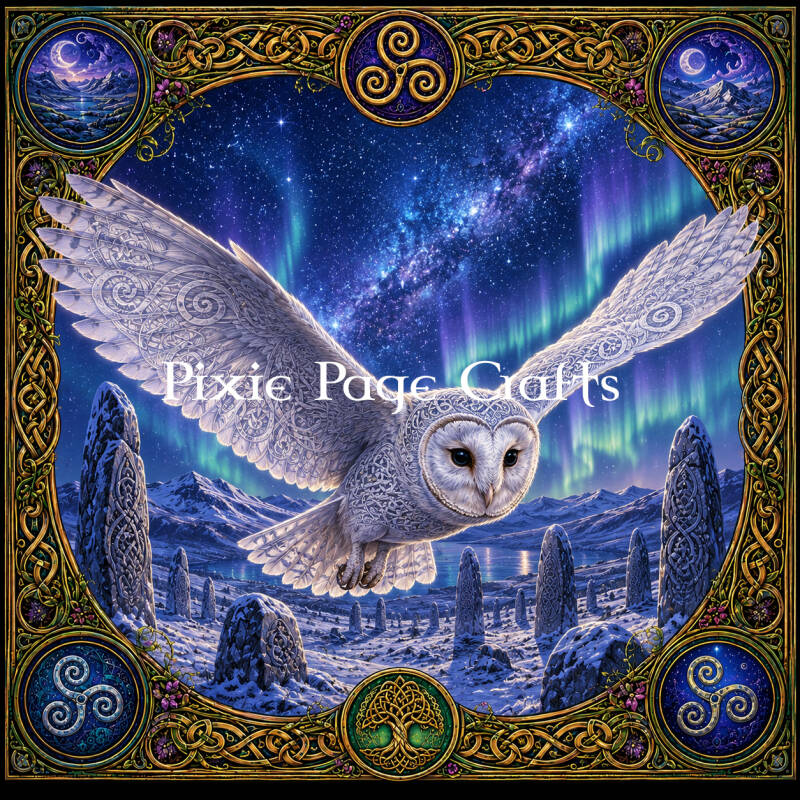
The Owl That Belongs to the Darkness
One reason the barn owl feels so appropriate to Pagan spirituality is simply the way it lives.
At sunset, the familiar daytime landscape changes.
Colours disappear. Shadows deepen. Human activity diminishes. Animals that have remained hidden during daylight begin to emerge.
And among them is the barn owl.
Its pale body can suddenly appear against the darkness and then vanish again almost without making a sound.
To earlier rural communities, an encounter like this could be deeply mysterious. Before electric lighting transformed our nights, darkness was genuinely dark. Hearing an unfamiliar screech or seeing a pale bird silently crossing the moonlit landscape could understandably inspire supernatural stories.
This gives the owl an especially powerful association with liminality.
A liminal state exists on a boundary: dawn and dusk, land and water, summer and winter, life and death, inside and outside.
These boundaries appear repeatedly in Celtic mythology and folklore.
The barn owl emerges at precisely one of them — the transition from daylight into darkness.
Symbolically, it therefore becomes a creature capable of moving between worlds.
The Owl and the Celtic Otherworld
The idea of an Otherworld appears repeatedly within Irish and Welsh mythological traditions.
It isn't quite the same thing as the Christian heaven or hell. Depending upon the story, supernatural realms can be associated with extraordinary landscapes, feasting, youth, supernatural beings, the dead or places where the normal rules governing human existence no longer apply.
Sometimes the boundary separating the human world from these mysterious realms seems surprisingly thin.
Water, caves, mounds and unusual landscapes can become gateways.
And sometimes particular times matter too.
This is where the owl fits beautifully into modern Celtic-inspired symbolism.
The owl operates beyond the edge of ordinary human perception. It can hear and locate prey in darkness where we would struggle to see anything at all.
Metaphorically, the owl therefore becomes the creature that sees what remains hidden from us.
That lends itself naturally to ideas of intuition, prophecy and hidden knowledge.
Blodeuwedd: The Most Important Owl in Welsh Mythology
One of the strongest genuine connections between owls and Celtic-language mythology comes from medieval Wales.
In the Fourth Branch of the Mabinogi, the magicians Math and Gwydion create a woman from flowers to become the wife of Lleu Llaw Gyffes.
Her name is Blodeuedd, although the form Blodeuwedd has become particularly familiar today.
She eventually falls in love with another man, Gronw Pebr, and conspires with him to kill Lleu. Lleu survives, and Gwydion later punishes Blodeuedd by transforming her into an owl.
This is important because modern retellings sometimes present Blodeuwedd simply as an ancient Celtic “owl goddess.”
The surviving medieval story is much more complicated.
Her transformation into an owl is explicitly a punishment. Gwydion condemns her to live apart from other birds and to experience their hostility.
Yet mythology rarely remains frozen. Within some forms of modern Paganism, Blodeuwedd has been reinterpreted very differently.
Her story can represent independence, sexuality, betrayal, consequence, transformation and female sovereignty. Her transformation into the owl can consequently be viewed not merely as punishment but as a profound change of identity.
The owl becomes a creature that has passed through darkness and emerged transformed.
That is a remarkably powerful Pagan theme.
Seeing What Others Cannot
Perhaps the most beautiful symbolic interpretation of the barn owl comes from its ability to function in darkness.
When humans lose much of their ability to see, the owl continues.
Its senses are adapted for locating prey under extremely low-light conditions, with hearing playing an especially important role.
That physical reality lends itself wonderfully to spiritual symbolism.
The owl can represent the ability to look beneath appearances.
In modern Pagan interpretation, this can become intuition.
Not necessarily supernatural fortune-telling, but the ability to recognise something that isn't immediately obvious.
It might represent listening to instinct.
Understanding yourself.
Recognising uncomfortable truths.
Or finding direction during a difficult period of life.
The darkness doesn't blind the owl.
The darkness is where the owl becomes most capable.
Silent Flight and the Power of Observation
The barn owl possesses another remarkable adaptation: extraordinarily quiet flight.
Its feathers help reduce aerodynamic noise, allowing it to approach prey with remarkable stealth.
Symbolically, there is something powerful in this.
The owl doesn't crash through the darkness announcing its arrival.
It listens.
It observes.
It waits.
Then it acts.
Within modern Pagan spirituality, this can represent patience, awareness and wisdom.
There is an interesting lesson within that symbolism.
Strength doesn't always have to be loud.
Sometimes the strongest position is to watch, listen and understand before acting.
Owls, Death and Omens
Owls haven't always been regarded positively.
Across European folklore, their nocturnal behaviour and strange calls have sometimes connected them with death, misfortune and omens.
This isn't particularly surprising.
Humans naturally associated darkness with danger. A mysterious animal heard during the night — particularly one with an eerie call — was an obvious candidate for supernatural interpretation.
But Pagan interpretations of death can be considerably more nuanced than simply treating it as something evil.
Nature itself is cyclical. A plant germinates. It grows. It flowers. It produces seed. It dies. The seed remains.
And eventually life begins again. The seasons perform the same cycle. Spring becomes summer. Summer becomes autumn. Autumn becomes winter. Winter eventually becomes spring.
Consequently, death can symbolise transition rather than absolute ending.
An owl associated with darkness and death can therefore simultaneously represent transformation and renewal.
The Barn Owl and Samhain
This makes the barn owl particularly appropriate to modern imagery surrounding Samhain.
Samhain has historical roots in Irish seasonal tradition and marks the transition into winter. Medieval literature also associates Samhain with extraordinary and supernatural events.
Modern Pagan traditions frequently make Samhain a time for remembering ancestors and contemplating mortality.
The owl fits naturally into this atmosphere.
Imagine the landscape at Samhain.
The harvest is ending.
Leaves have fallen.
The evenings are rapidly becoming darker.
Mist settles across the fields.
The natural world appears to be withdrawing.
Then a white owl emerges silently from the darkness.
In Celtic-inspired artwork, it almost becomes a guardian standing at the entrance to winter.
Not a symbol of evil.
A watcher at the threshold.
The Moon and the Barn Owl
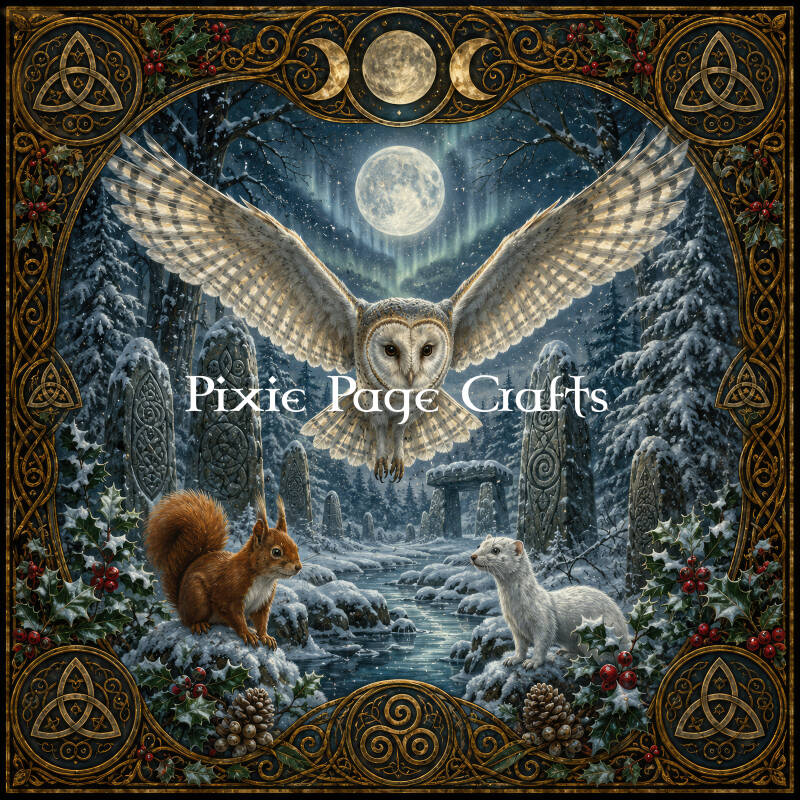
The owl and moon have become almost inseparable in modern Pagan artwork.
Historically, we should be cautious about claiming that ancient Celtic people universally regarded owls as sacred lunar animals. There simply isn't sufficient evidence for such a sweeping statement.
But as modern symbolism, the relationship makes perfect sense.
The barn owl belongs to the night.
The Moon rules our visual experience of the night sky.
The Moon also visibly changes throughout the month — waxing, becoming full, waning and apparently disappearing before returning.
That makes it a natural symbol of cycles, change, renewal and transformation.
Modern Pagan traditions may also associate the Moon with intuition, feminine divinity and different phases of spiritual or personal development.
Place the owl beneath a crescent or full moon and the two symbols reinforce one another:
Moon — cycles and transformation.
Owl — perception and hidden knowledge.
Together they create an exceptionally powerful piece of Pagan imagery.
The White Owl as a Spirit-Like Creature
The barn owl's colouring adds another layer.
A pale barn owl flying through darkness can appear almost ghostlike.
It is easy to imagine how sightings might have inspired stories of spirits, apparitions or supernatural messengers.
Its face contributes to the effect.
Unlike many birds, the barn owl's heart-shaped facial disc gives it an unusually distinctive appearance. Seen briefly in poor light, the face can look startlingly pale and almost mask-like.
This makes the barn owl ideal for representing a creature that exists somewhere between the familiar and supernatural.
It is unquestionably a real animal.
Yet it doesn't always feel ordinary.
Guardian of Ancient Places
Another particularly effective modern Celtic interpretation is the owl as guardian of ancient places.
This is why imagery showing owls among standing stones, ancient woodland and mountains works so well.
There isn't historical evidence that barn owls were literally appointed guardians of Celtic stone circles.
In fact, many of Britain's famous stone circles and standing stones considerably predate what historians usually call Celtic culture.
But folklore has always attached new stories to old landscapes.
People encounter an ancient monument without knowing who constructed it.
Stories emerge.
Fairies built it.
Giants threw the stones.
Witches gathered there.
Spirits inhabit it.
The supernatural explanation becomes part of the monument's later history.
The owl works beautifully within this tradition because it is another ancient presence within the landscape.
Civilisations rise and fall.
Buildings appear and disappear.
Generations of people come and go.
But owls continue flying over the fields.
Symbolically, the owl becomes a keeper of the memory of the land.
The Owl as a Messenger
Animals frequently act as intermediaries in mythology.
Birds are particularly suited to this role because they inhabit two environments.
They walk upon the earth but can disappear into the sky.
A nocturnal bird adds another boundary.
The barn owl therefore crosses:
Earth and sky.
Light and darkness.
Visibility and invisibility.
In symbolic terms, that makes it an ideal messenger between different states of existence.
Modern Celtic and Pagan imagery can consequently portray the owl as carrying knowledge between the natural and spiritual worlds.
Again, this shouldn't be presented as a universal ancient Celtic doctrine.
It is a modern interpretation built from characteristics that have made birds spiritually significant across many cultures.
Wisdom — With an Important Qualification
Today, almost everyone recognises the owl as a symbol of wisdom.
But the idea that “the Celts believed owls symbolised wisdom” is too simplistic.
The famous Western association between owls and wisdom owes a great deal to classical Greek tradition, particularly the owl associated with Athena.
Celtic-language traditions have their own owl stories, but they don't simply duplicate the Greek symbolism.
Nevertheless, wisdom has become so firmly attached to the owl in modern culture that it now forms an important part of contemporary Pagan imagery.
And the symbolism remains appropriate.
The owl listens.
The owl observes.
The owl navigates darkness.
The owl notices what humans cannot.
That is an excellent metaphor for wisdom.
Transformation Is Perhaps the Strongest Connection
If one idea connects many of these themes, it is transformation.
Blodeuwedd is transformed into an owl.
The owl emerges as day transforms into night.
The Moon changes through its phases.
The seasons change.
Life becomes death.
Winter becomes spring.
And Pagan traditions frequently celebrate these cycles rather than attempting to separate them.
The owl therefore becomes a particularly effective representation of accepting change.
It reminds us that transformation can be frightening.
It can involve darkness.
It can mean leaving behind something familiar.
But darkness isn't necessarily the end of the journey.
Why the Barn Owl Remains Such a Powerful Pagan Symbol
The modern spiritual significance of the barn owl ultimately comes from a combination of nature, mythology and human imagination.
It isn't necessary to invent historical claims about ancient Celts worshipping barn owls to make the animal meaningful.
The reality is powerful enough.
The barn owl genuinely does emerge into darkness.
It genuinely does fly almost silently.
It genuinely possesses extraordinary senses.
And owls genuinely appear within Welsh mythology and later British and Irish folklore.
Modern Pagan spirituality has taken those characteristics and interpreted them through ideas including:
Wisdom • intuition • transformation • mystery • independence • death and rebirth • the Otherworld • night • hidden knowledge • spiritual boundaries • observation • ancestral memory
Perhaps the most powerful way of understanding the barn owl is therefore not as a creature that defeats darkness.
It doesn't need to.
The barn owl enters the darkness, understands it and finds its way through.
That is why it works so beautifully alongside the moon, Celtic knotwork, ancient stones and wild landscapes in Celtic and Pagan-inspired artwork.
It represents something deeply human: our desire to understand what we cannot see, to find our way through uncertainty, and to believe that beyond the edge of the familiar world there may still be mysteries waiting to be discovered.
The barn owl is not simply a bird of the night. In Celtic and Pagan-inspired folklore, it has become a symbol of what might be waiting just beyond the light.