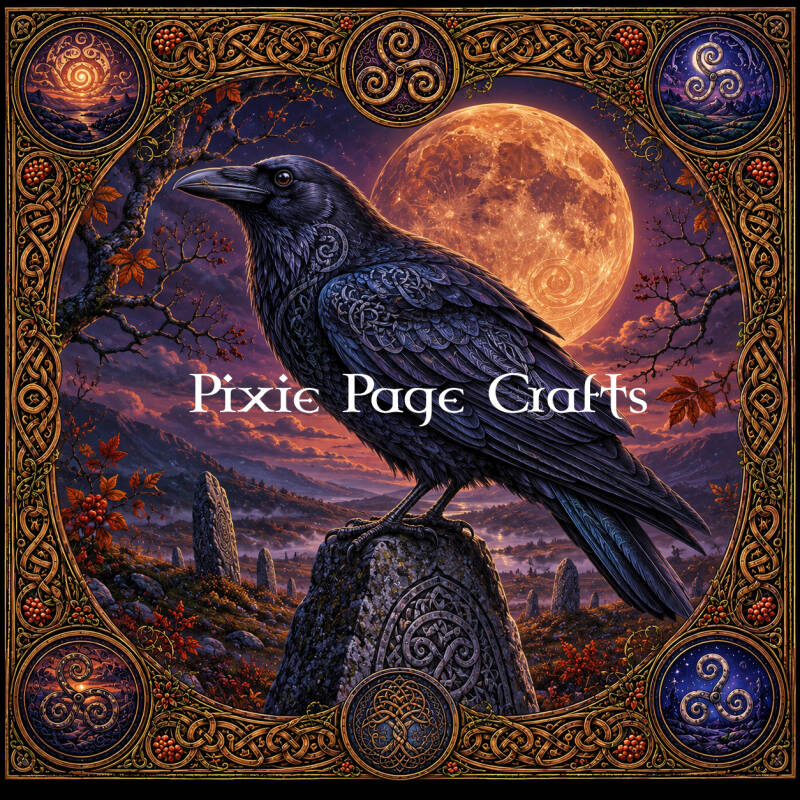
The Raven
The Raven in Celtic and Pagan Folklore
The raven holds a particularly powerful place in Celtic mythology and later folklore, where its dark plumage, intelligence and distinctive voice helped give it an atmosphere of mystery and supernatural importance. Ravens are highly intelligent birds capable of solving problems, remembering individuals and adapting their behaviour to changing circumstances. Their ability to appear suddenly, observe from a distance and seemingly watch human activity made them natural candidates for stories involving wisdom, prophecy, hidden knowledge and communication with the unseen world. In modern Pagan symbolism, the raven often represents someone capable of looking beyond appearances and discovering truths that others might overlook.
Perhaps the raven's most famous Celtic connection comes through the Morrígan, a complex supernatural figure in medieval Irish literature associated with warfare, sovereignty, fate and prophecy. She is connected in the surviving stories with ravens or crow-like birds and sometimes appears around scenes of conflict and death. This helped strengthen the raven's later reputation as a bird capable of moving between the worlds of the living and the dead. Rather than simply representing death or evil, however, the raven can be understood as a witness to transformation and the inevitable cycles of existence — present when one chapter ends and another begins.
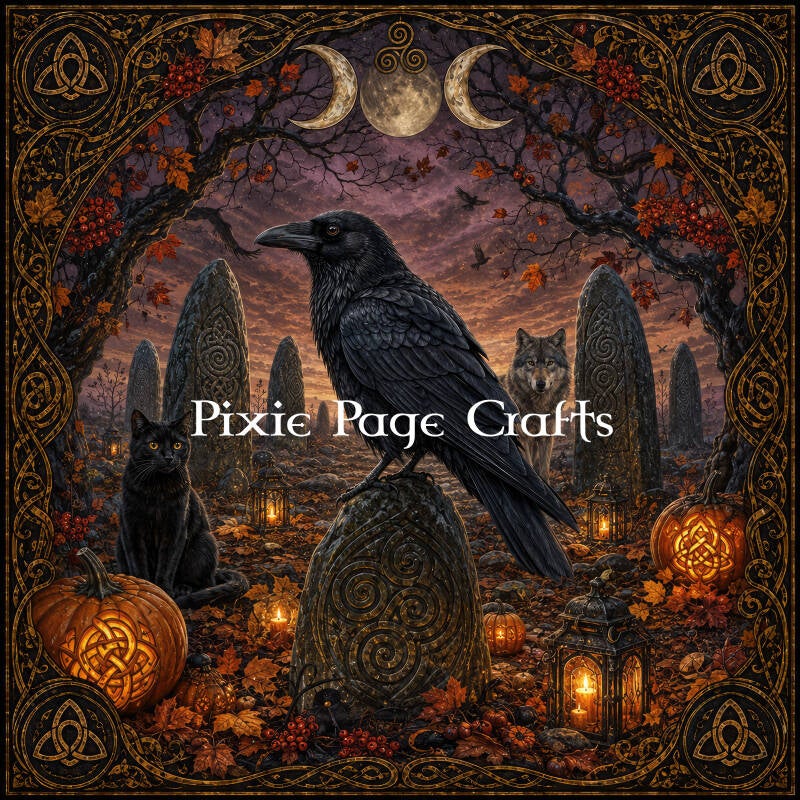
The raven's association with battlefields and death also has a perfectly natural explanation. Ravens are scavengers and would have been attracted to places where animals or people had died. To ancient observers, seeing these great black birds gathering after conflict must have been an unforgettable sight. Within mythology, this natural behaviour could acquire supernatural significance, linking ravens with fate, mortality and prophecy. Modern Pagan traditions often interpret this more positively as a reminder that death is part of nature's continuing cycle of life, decay and renewal, rather than something existing outside the natural order.
Ravens also fit beautifully into the Celtic idea of liminal spaces and the Otherworld. They travel effortlessly between earth and sky, appear in lonely mountains and wild landscapes, and possess an intelligence that can sometimes make their behaviour seem almost deliberate. In Celtic-inspired and Pagan artwork, a raven perched upon an ancient stone beneath the Moon can therefore become a symbolic guardian or messenger standing between the visible and invisible worlds. Its black feathers contrast dramatically with moonlight, mist and fire, reinforcing associations with mystery, intuition and the unknown.
Ultimately, the raven's enduring significance comes from the remarkable combination of mythology, natural behaviour and centuries of human storytelling. We should avoid the modern simplification that every ancient Celtic person believed “the raven means prophecy,” because Celtic traditions differed greatly between regions and periods. Nevertheless, the raven genuinely occupies an important place in Irish mythology and remains one of the strongest animals for modern Celtic and Pagan-inspired symbolism. It can represent wisdom, transformation, prophecy, courage, fate, death and renewal — a dark-feathered watcher that reminds us that the mysterious parts of nature are not necessarily something to fear, but something worthy of respect and understanding.